Study templates
A template is a study with its parts in place. Pick one when you start a new study, change anything in it, and add your own images or videos where it asks. Open an example study of 48 made-up people, with its Results page and a real download, before you build your own.
The daily-life templates are whole studies made from the starters on the builder's Daily life tab.
11
study templates
on Start a study
3
daily-life starters
templates too, and on the builder's Daily life tab
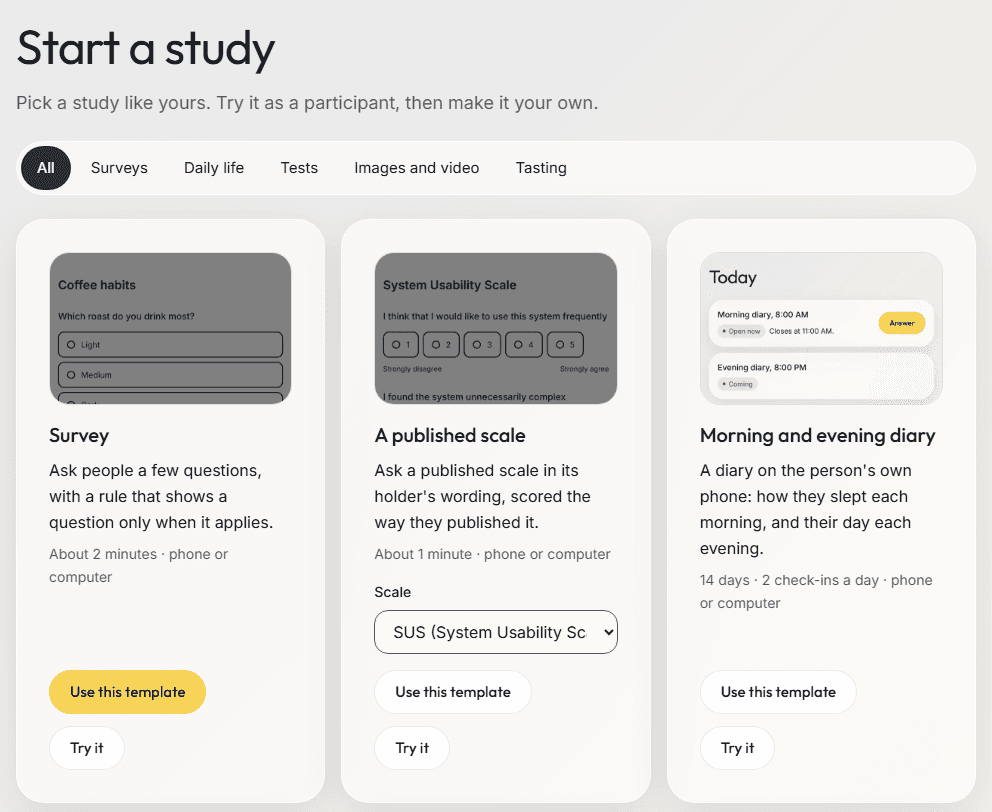
Survey
Ask people a few questions, with a rule that shows a question only when it applies.
- What it holds
- Instructions, then one questionnaire: a single choice, a multiple choice, a rating, a yes or no question, a number asked only after a yes, and a long text. The camera is off.
- Camera
- Off
A published scale
Ask a published scale in its holder's wording, scored the way they published it.
- What it holds
- Instructions, then one published scale as its holder wrote it, with its scores: PHQ-8, GAD-7, SUS, 50-item IPIP Big-Five Factor Markers, TIPI, SWLS, PHQ-2, GAD-2, PHQ-4, PHQ-15 or GDS-15. The camera is off.
- Camera
- Off
Delphi panel
Rate statements over rounds with an expert panel, who see the group's ratings between rounds and can change theirs.
- What it holds
- A first round and two more, each open 14 days. Each statement on its own screen: from round 2 the panel's median and middle half, then a rating from 1 to 9 and a comment. A statement at consensus drops out. The camera is off.
- Camera
- Off
- Know first
- Each round opens when you close the round before on the Participants page.
Morning and evening diary
A diary on the person's own phone: how they slept each morning, and their day each evening.
- What it holds
- Instructions and a short questionnaire about sleep. Then check-ins on the person's own phone: a morning diary about sleep and an evening diary about the day, for 14 days. The camera is off.
- Camera
- Off
Five check-ins a day
Short check-ins on the person's own phone at times they cannot predict: mood, stress, place and company.
- What it holds
- Instructions and a short questionnaire about the past month. Then check-ins on the person's own phone: one random check-in in each of five windows from 8 AM to 8:30 PM, for 14 days: mood, stress, place, and company. The camera is off.
- Camera
- Off
Symptom log
People log a symptom on their own phone when it starts, with an evening check for anything missed.
- What it holds
- Instructions and a short questionnaire about their symptoms. Then check-ins on the person's own phone: participants log symptoms when they happen, with an evening check for anything missed, for 28 days. The camera is off.
- Camera
- Off
Classic test with face
Run a classic test and record the face while people do it.
- What it holds
- Instructions, the Stroop test, and one question about how hard it was. The face camera is on. You can choose another test for the test part.
- Camera
- Face
Association test with ratings
Measure an association with a timed sorting test, and ask for the same attitude in words.
- What it holds
- Instructions, the association test, and two rating questions. The camera is off.
- Camera
- Off
- Know first
- The built-in association test pairs flowers and insects with pleasant and unpleasant words. It does not take words or images of your own yet.
Pack or shelf test
See how people look at product packs, and how much they like each one.
- What it holds
- Instructions, then three empty image parts in a random order. Each is followed by a liking question and a purchase question. Face and gaze are on.
- Camera
- Face and gaze
- What you add
- Your own images or videos, after you make the study.
Ad or concept test
Compare two ads or concepts. Each person sees one of them.
- What it holds
- Instructions, then one empty image or video part for each of two balanced groups. Each is followed by a recall question, an attitude rating and a purchase rating. The face camera is on.
- Camera
- Face
- What you add
- Your own images or videos, after you make the study.
Tasting
Compare samples that people taste, such as foods or drinks, on a tablet in a booth.
- What it holds
- Instructions, then three samples in a counterbalanced order with a rinse break between them. After each sample: a liking scale, a flavor scale and a list of words to tick. The camera is off.
- Camera
- Off
- Know first
- You write the words to tick, and you decide what each code stands for.
Daily-life starters
Check-ins on the person's own phone. Each is a template on Start a study, and a starter on the builder's Daily life tab.
| Starter | What it holds |
|---|---|
| Five check-ins a day | One random check-in in each of five windows from 8 AM to 8:30 PM, for 14 days: mood, stress, place, and company. |
| Morning and evening diary | A morning diary about sleep and an evening diary about the day, for 14 days. |
| Symptom log | Participants log symptoms when they happen, with an evening check for anything missed, for 28 days. |
How it works
- Start a study, and choose a template.
- Add what it leaves empty, such as your images or video, or the words to tick.
- Change anything else in the builder. Then check, preview and publish it.
Related
Study builder
Every tab of the builder, from parts to groups, orders, samples and visits.
Daily-life check-ins
EMA on the person's phone, from a starter or your own design.
Sensory testing
Coded samples, balanced serving orders and a staff PIN, on tablets in booths.
Survey software
The question types, rules, scores and languages of the questionnaire editor.
Planning a study?
Start one now, or tell us what you want to measure.