EMA software for research
Run ecological momentary assessment (EMA) studies in one place: design the check-ins, set people up on their phones, follow adherence, and export every check-in.
Check-ins sit in the same study as lab sessions with questionnaires, cognitive tests, and face and gaze, so one export holds both.
What EMA measures
Ecological momentary assessment (EMA) asks people about their experience close to when it happens, in daily life, instead of asking them to remember it weeks later. Studies use it for mood, stress, pain, fatigue, cravings, sleep, and symptoms, because answers given in the moment depend less on memory.
Sampling designs
| Design | Also called | How it works |
|---|---|---|
| Fixed times | Interval-contingent | Check-ins at set local times, such as 8 AM and 8 PM, on the days you choose. |
| Random times | Signal-contingent | A set number of check-ins at random times in a window, with a minimum gap. Each time stays secret until it is due. |
| One per window | Stratified random | One check-in at a random time inside each window you define. |
| Participant-started | Event-contingent | Participants open a check-in when an event happens, up to a limit you set for each day. |
Mix designs in one study, for example random check-ins during the day, an evening diary, and a symptom log the person opens when a symptom starts.
What participants do
- After the first session, open the set-up link on a phone. The end screen shows it as a QR code.
- Add the page to the Home Screen, turn notifications on and send a test, then confirm the time zone and press Start.
- Get a reminder when a check-in is due, and answer it on the Today page. An answer given with no network, photos and files included, is kept on the phone and sent when the network is back.
- See past check-ins in History, and add the fixed times to the phone's calendar.
What you get
- The builder's Daily life tab: Moments at fixed or random times, in windows or started by the person, with reminder times, quiet hours, how long each stays open, and a questionnaire for each, written in the same editor as the study's other questionnaires.
- A check-in can offer pictures as answer choices and ask for a photo or a PDF file, up to 10 MB each, such as a photo of a meal. A photo's location and camera details are removed before it is sent.
- Starters: five check-ins a day, a morning and evening diary, and a symptom log.
- Reminders at each check-in's time, with every attempt and delivery kept in the record.
- Check-in screens and reminders come in English, Spanish, French, German, Italian, Japanese, Chinese (Simplified) and Portuguese (Brazil). Each person gets the language they joined the study in.
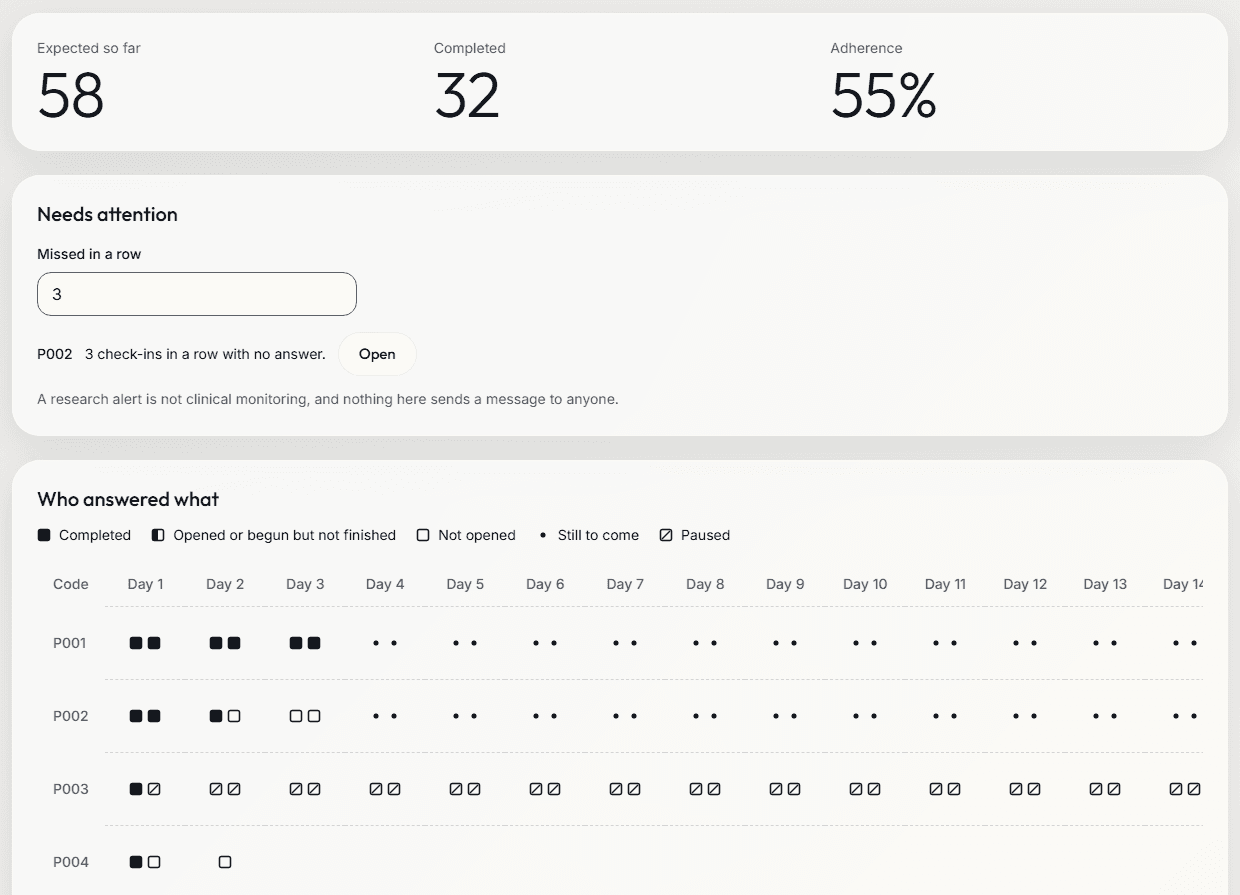
- The Daily life page: expected, completed and adherence, who answered what, who has reminders off, and who missed several check-ins in a row.
- Pause, resume or end one person's check-ins, and move everyone to a new version from their next study day.
- An export with a row for every check-in, planned or started, every reminder sent, a summary for each person, a table of answers for each questionnaire, and the files people added.
Limits
- Reminders reach a phone that added the page to its Home Screen and allowed notifications. A phone that cannot get them is told so, and can still open its check-ins.
- Up to 24 scheduled check-ins a day for each person.
- Check-ins run in the phone's browser. There is no app to install.
Pricing
Free for pilots and teaching. Researcher is $199 a year and Lab is $799 a year, with unlimited questions and check-ins.
See pricingRelated
Survey software
The question types, rules, scores and languages of the questionnaire editor, which check-ins use too.
Longitudinal studies
Later visits inside windows you set, with check-ins between them in the same study.
Study builder
The parts, groups, orders and versions of the study the check-ins belong to.
Measures
Cognitive tests, face and gaze, and stimuli and events, for the lab sessions of the same study.
Planning a study?
Start one now, or tell us what you want to measure.